Dependencies
From APIDesign
Contents |
Dependencies
Not many APIs can live alone, without support from other parts of the system. Every C application or library needs libc, every Java code needs some version of JDK. As each library, also APIs have own environment, which defines what needs to be available around to allow the API to function properly. Each user of such shared library needs to recreate proper environment, that means to satisfy its dependencies, before its API can be used. This implies, that the dependencies of a library form an important API of the shared library itself.
These dependencies may not even be visible in external signatures (more about that in TypesOfDependencies)! They may only be needed during the runtime, internally, still changing them constitutes an API change. Imagine, that users of your API are using your library in some version and it works fine with just plain JDK. Suddenly, in newer release, you decide to change the library internals and depend on some other library, for example Jakarta Commons. That immediately means every user, who migrates to new version of your library, needs to include a version of Jakarta Commons in own application as well. This may or may not be a problem, however this is quite an externally visible change.
As the Chapter 3 defines APIs as everything that is externally visible, it makes sense to include shared library dependencies into the family of various types of APIs. In spite the fact, that it is very hidden kind of API, it is in fact one of the highest level kind and the API that we deal with the most during our day to day work.
Specifying Dependencies
Dependencies are usually specified as set of pairs. First element in each pair contains unique identification of needed API and also some specification of the API versions. Depending on the actual module system, the dependencies may be equality, greater than or even specified as a range.
It is important to mention that dependencies are almost always simplification of the real environment required. People often say: my library needs Java version 1.3, or version 1.5, while in fact then may mean: my application needs class JNDI (introduce as part of Java 1.3). Or my application requires annotations (added in version 1.5). That is more precise, however such exact description of own's dependencies is very complex and verbose. Much easier to simplify each dependency to just one number (with some interpretation).
Equality
One can depend on exact certain version of other library. This is however very restricting. If there is a part of application that needs Java 1.3 and another that needs Java 1.5, will you run each part of the application in different VM?
Thus this kind of dependency is useful only for modules which can be used separately, but are built and deployed together.
Greater Or Equal
For modules deployed individually one needs to allow certain freedom. The equality dependency is too restricting. Often people use equal or greater than dependency. This follows the usually accepted expectation that if program runs on Java 1.3, it will also run (relatively) fine on Java 1.5.
This of course requires the vendor of the library to follow rules of BackwardCompatibility - e.g. really design and especially evolve the API well. However most people designing commonly used libraries understand this and thus we can mostly rely on >= dependencies.
Need for Incompatible Version
In life of every API comes a moment when its provider needs to make an incompatible change. There is no way around it. Even Solaris, the most compatible software project I am aware of, needs to make an incompatible change in some published interface from time to time. Moreover BackwardCompatibility in Solaris is the most important mantra, in regular libraries, it may not be adhered to so strongly. Of course, it is better to find a way to provide AlternativeBehaviour, but sometimes there is really no backward compatible way around.
Then one needs to express the incompatibility in the versioning. Usually there is some major version number that, once increased means that the new version is no longer compatible with the previous one. This shall be used rarely, but each module system needs to provide some way of expressing incompatible versions.
Common way to implement this is to associate with each version an implicit upper bound. So when one writes  one actually means any give me some library at least in version 1.4.3 but not 2.0 or higher. From here there is just a little step towards RangeDependencies.
RangeDependencies
Dependencies are important part of every Module system. Dependencies are here to abstract the complex relationship between a module and environment it needs for its own execution, compilation, linkage, etc. Dependencies are always a simplification of the real requirements, but that does not stop people from inventing new and new ways to specify them more precisely.
It has already been discussed that dependency needs some lower bound (the moment when the needed API is first introduced) and also some higher bound (as incompatible changes are so often). How do we formalize it? Well, let's use some mathematics and describe dependencies as interval! As a result a dependency on any compatible version 1.4.3 and later (in the interpretation of semantic versioning), would be written as  .
.
This looks like a very good solution. It is also very rationalistic. It is reusing knowledge gained and verified by mathematicians in the past. How could something like that be wrong!? Moreover it is general enough - one can use the same notation to express equality dependency by writing ![some.library \in [1.4.3, 1.4.3]](/images/math/2/4/a/24a56f8f4b97c64ce4903b242eed1f51.png) . And also it is more flexible as one can also depend on a smaller range
. And also it is more flexible as one can also depend on a smaller range  or larger range
  . Last, but not least this solution also supports some level of cluelessness as it builds on something every programmer must have heard about during own school days.
No wonder that everyone one who wants to be seen as providing well designed, deeply thought out, powerful and theoretically backed solution will choose intervals. This is probably the reason why OSGi decided to use this kind of dependencies. However there is important hidden catch: Too Much Flexibility may lead to NP-Complete (e.g. almost unsolvable problems). This page outlines the problems as well as possible solution to avoid NP-Completeness.
Enhanced Range Dependencies
When analysing dependencies it can be easily proven that RangeDependencies (as used by OSGi) are too flexible and may lead to NP-Complete problems. However recently I started to ask following question - it is known that module configuration problem can be fixed by generating so called complete repositories. Can't the same trick be applied to repositories using RangeDependencies as well?
My current feeling is that it can. This page is my attempt to formalize that feeling.
Lower Bound
Each dependency has a lower bound, a minimal required version of a library that we can work against. When producing our application, it is in our interest to verify that we can really compile and create our application against the lower bound. The easiest way to ensure we are using only classes and methods available in such lower bound version is to compile against the lower bound version of each library we define a dependency on.
Or from the opposite perspective: Compiling against newer version than the lower bound is too errorprone. NetBeans allows this during development cycle, when things are changing rapidly, this often leads to LinkageErrors that render the whole application unusable at random and unexpected moments.
Lower bound is the version that we compile against.
Upper bound
Upper bound on the other hand is the version that we know we can still work with.
There are just two vague verbs in the previous sentence. What does it mean to know?
- Know can mean to be sure. E.g. we have verified that we really work with that version. We have downloaded that version of a library, executed all our tests and certified it. We really checked our application works with that version. In some situations this kind of knowledge is required.
- Know can however mean to believe. Often we can trust the producer of the library, that they will conform to some versioning scheme (like Semantic versioning) and based on such trust we can estimate the upper bound (even sooner than the newer versions of that library are produced).
What does it mean to work?
- Work can mean really runs as expected and this kind of verification is hard, tough to automate. It requires work of a quality department and is more a process decision than something scientifically definable.
- Work can be reduced to links, this is definitely much less satisfying answer (but at least it prevents the linkage errors, so it gives the application a chance to recover), but it is easily measurable. BinaryCompatibility can be verified by tools like Sigtest.
In case we want to believe our application will sort of work and for sure at least link to new version, it is better to use predefined, widely accepted RangeDependencies - e.g. when using a library with lower bound 1.5, the upper bound would automatically be 2.0. The range would be  .
.
If one wants to be sure application really runs as expected, it is wiser to specify narrow range. If version 1.5 is the newest version, one can even use ![[1.5, 1.5]](/images/math/c/5/2/c52a9f99faa7a850d860b8bc5257da6f.png) and only when new versions are released, release new versions of the application and expand the range to
and only when new versions are released, release new versions of the application and expand the range to ![[1.5, 1.6]](/images/math/8/e/8/8e82c9ca063d0c25ef24c311a1ecc0cd.png) .
.
The latter, paranoiac approach, is likely to be used more often in end user applications. The first, optimistic one, seems more suitable for reusable libraries.
Stability of Published API
How one specifies how stable just published API is? The semantic versioning suggests to treat all releases up to changed major version (e.g. up to 2.0.0) as being BinaryCompatible. The NetBeans API Stability proposal allows each API to be attributed as stable, devel or private. The netbeans:NbmPackageStability goes even further and suggests to use different ranges for different stability of the API. Is this the right approach?
In ideal, rationalistic world, it is. Under the assumption that API designers are rationalistic and understand the versioning issues and the importance of proper dependency management, it is fine to expect that they will do everything to follow principles of semantic versioning (or netbeans:NbmPackageStability guidelines) and either keep BackwardCompatibility or bump the major version. In rationalistic world, it is enough to believe our application will sort of work and at least link and the rest will be achieved by the good work of the other, rationalistic people.
The trouble is that we live in clueless world and most of the people (including API designers) don't have time to fully evaluate negative influence of their changes. When producers of up-stream library make a mistake, there should be a way for the consumers of such API to recover and shield themselves. From this thought there is just a small step to the idea of giving the users of an API right to classify stability of the API they use. Here the range dependencies come into the play.
Should there be a repository of modules and their dependencies including module  in versions
  . If majority of other modules having a dependency on uses range
  (e.g. the classical range for semantic versioning), then we can deduce that the owner of module is doing good job keeping BackwardCompatibility. If many dependencies on use for example
  , then we can deduce that something unnatural (from the point of semantic versioning happened in version
  ) and that the owner of the module underestimated the impact of changes in version . On the other hand, if many dependencies on use range like
  then the incompatible change was probably not as incompatible as it might have seen.
The beauty of analysing the overall dependencies on a module is that it clearly expresses the statistical probability of BackwardCompatibility as seen by all users. It also allows the users to be sure application really runs as expected if the dependency is satisfied. Of course, the author of such API should set the expectations up by using stability category, but the ultimate decision remains in the hands of the API users.
Getting trapped by NP-Completeness
From the things described so far it seems that RangeDependencies may not be as bad, but still, there are severe NP-Complete problems associated with them. Following sections demonstrate the problems.
Module Repository with Ranges
Let  denote various modules and their APIs.
Let  denote versions of module
  . It is not really important what format the versions use, the only condition is that there is a linear order among the versions. As such the rest of the terminology is using single variable (
 or
or  ) to denote the version.
Let  denote the fact that version x of module A depends on version range
  of module B. E.g. any version of module B between u and less than v can be used to satisfy A's need. Let
 ![A_{x} \rightarrow B_{[u,v]}](/images/math/7/2/7/727583d093b7fd0618671f0fa9703a88.png) denote closed interval dependency and allow its usage as well.
denote closed interval dependency and allow its usage as well.
Let Repository  be any set of modules with their versions and their dependencies on other modules.
Let C be a Configuration in a repository , if
 , where following is satisfied:
- each dependency is satisfied with some version from dependency range:

- only one version is enabled:

Module Range Dependency Problem
Let there be a repository and a module  . Does there exist a configuration
  in the repository
  , such that the module
  , e.g. the module can be enabled?
Conversion of 3SAT to Module Range Dependencies Problem
Let there be 3SAT formula with variables  as defined at in the original proof.
Let's create a repository of modules . For each variable  let's create two modules
  and
and  , and put them into repository .
For each formula
 let's create a module
  that will have three versions. Each of them will depend on one variable's module. In case the variable is used with negation, it will depend on version 1.0, otherwise on version 1.1. So for formula

we will get:
![F^i_{1.1} \rightarrow M^a_{[1.1,1.1]}](/images/math/5/f/e/5fefb6a633c43cea3ddc4f6663c542d0.png)
![F^i_{1.2} \rightarrow M^b_{[1.0,1.0]}](/images/math/0/e/e/0ee4901e54e9fcbcd21f8b8ac673bea6.png)
![F^i_{1.3} \rightarrow M^c_{[1.0,1.0]}](/images/math/2/0/6/206c8ac84b354b3c1bd4d32192134cd1.png)
All these modules and dependencies are added into repository
Now we will create a module  that depends on all formulas:
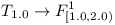
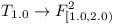
- ...

and add this module as well as its dependencies into repository .
Claim: There  (a configuration) of repository and
 there is a solution to the 3SAT formula.
The proof is step by step similar to the one given in LibraryReExportIsNPComplete, so it is not necessary to repeat it here.
Avoiding NP-Completeness
Still RangeDependencies seem powerful. If we could eliminate the NP-Complete problems associated with them! If we could effectively find out whether dependencies of a module can be satisfied! Following lines show a way to do it.
Complete Module Repository with Ranges
A repository is said to be complete if the transitive dependencies are explicitly enumerated:

This definition seems to make sense from the point of lower bound. When module A is being compiled, it can request higher version of a library C then any of its dependencies require. In some cases A may need to use some new API available in C, so the ability to rise the lower bound seems reasonable.
It does not make much sense to have higher upper bound of dependency on C higher than any existing upper bound on C among reused libraries (thus  ). The module A may however be incapable to work with the whole range of versions of C that its dependencies can. Thus A can restrict upper bound (e.g. make
  ).
).
No Longer NP-Complete
Following the steps of first attempt to extinguish NP-completeness the time comes to demonstrate that complete range module repositories avoid NP-Completeness (under the assumption P!=NP) and that they can naturally be generated and verified for consistency.
First of all, the above conversion of 3SAT problem to module range repository cannot be used for complete module range repository. The central part of the conversion relies on the fact that module has only indirect dependencies on  modules. Complete repositories prevent that.
The repository has to be populated incrementally by compiling new and new modules. Let's use this to demonstrate the construction of complete range repositories is possible in polynomial time:
module without dependencies - in almost any system there is at least one base module that does not have any dependencies. Computing set of dependencies of such module during compilation is obviously a constant operation.
When compiling a module with direct dependencies on  . We can assume that
  exist and have all their transitive dependencies explicitly enumerated and are consistent (otherwise they could not be part of the complete repository). Let's now collect all transitive dependencies of into a set
  and verify whether they are all consistent.
Compute the common denominator range for each module B:  , if:
, if:
-
 , then reject the merge, as there is no version of module B that could satisfy all dependencies
- otherwise use
 as the range dependency on B
Obviously this kind of computation can be done in polynomial time. Thus we can perform this check during every compilation. When we have new configuration, we just need to seek the repository and find out if for each module in the configuration we have an existing version of the module that we can compile against. If such version is found, it will be used as a lower bound for the newly compiled module. The upper bound will be the inferred one, unless the compiled module restricts it.
Implications
The stability of an API in complete range repository is ultimately decided by users of the API. In case the API remains compatible for many versions, the dependency ranges on such API will be wider.
For end user application modules it is OK if they use narrow dependency ranges on dependent APIs. When one controls the whole deployment, there is no problem using even equality range (like [1.3, 1.3]) - quality assurance departments love when they can test the final application only in a single configuration of modules.
For a widely used API narrow ranges form a problem. They tight together the API with the others basically prescribing everyone what dependencies one has to have on all of the APIs taking freedom from the API users. Flexibility is needed when producing a framework.
Some kind of future expectations should be provided by the library vendors (in form of semantic versioning or stability classification) and for many purposes users can rely on such future defined open range. On the other hand, when something goes wrong, narrowing the range returns the control over versioning to hands of the API users.

